According to the International Energy Agency (IEA) and the U.S. Department of Energy (DOE), electric motor-driven systems — pumps, fans, compressors, conveyors, and process machinery — account for roughly 45 percent of global electricity consumption and nearly 70 percent of total industrial electricity demand. Yet when a 75 kW pump motor fails on a plant floor, procurement teams still routinely focus on the upfront purchase price difference of $1,500 between an older IE3 replacement and a super-premium IE4 or ultra-premium IE5 unit.
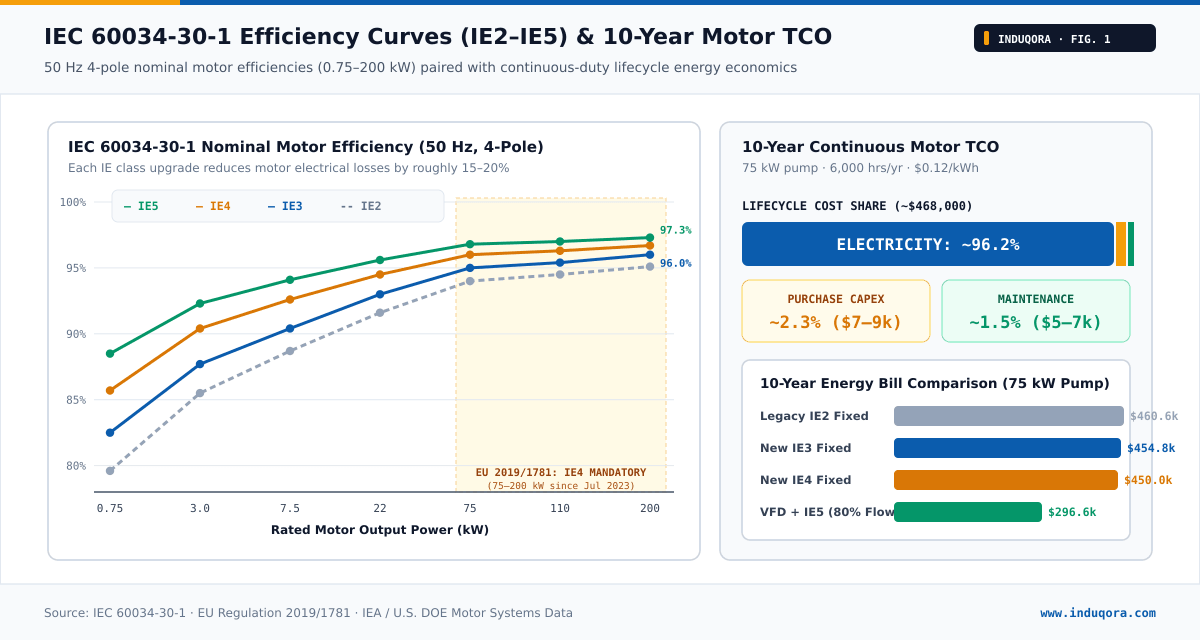
That purchasing bias ignores the fundamental economics of industrial rotating machinery: over a 10-year operating life at 6,000 hours per year, electricity accounts for 95 to 97 percent of a motor's Total Cost of Ownership (TCO), while initial capital purchase represents only 2 to 3 percent and maintenance 1 to 2 percent. Combined with tightening European Ecodesign and U.S. DOE federal mandates, motor efficiency engineering has become both a compliance obligation and one of the fastest-paying capital projects in smart manufacturing.
Official IEC 60034-30-1 Efficiency Classes (IE2 through IE5)
IEC 60034-30-1 defines globally harmonized International Efficiency (IE) classes for line-operated AC motors (50 Hz and 60 Hz, 0.12 kW to 1,000 kW), while IEC TS 60034-30-2 extends classification to variable-speed motors (such as Synchronous Reluctance and Permanent Magnet designs) that operate exclusively with a VFD. Each step up in IE class reduces total motor electrical losses by approximately 15 to 20 percent.
Nominal Full-Load Efficiency Table (50 Hz, 4-Pole Motors)
| Rated Output Power | IE2 (High) | IE3 (Premium) | IE4 (Super Premium) | IE5 (Ultra Premium, IEC TS 60034-30-2 ref) | Loss Reduction (IE3 → IE5) |
|---|---|---|---|---|---|
| 0.75 kW (1 HP) | 79.6% | 82.5% | 85.7% | ~88.5% | ~39% lower losses |
| 3.0 kW (4 HP) | 85.5% | 87.7% | 90.4% | ~92.3% | ~40% lower losses |
| 7.5 kW (10 HP) | 88.7% | 90.4% | 92.6% | ~94.1% | ~41% lower losses |
| 22 kW (30 HP) | 91.6% | 93.0% | 94.5% | ~95.6% | ~39% lower losses |
| 75 kW (100 HP) | 94.0% | 95.0% | 96.0% | ~96.8% | ~37% lower losses |
| 110 kW (150 HP) | 94.5% | 95.4% | 96.3% | ~97.0% | ~36% lower losses |
| 200 kW (270 HP) | 95.1% | 96.0% | 96.7% | ~97.3% | ~34% lower losses |
Note: 60 Hz NEMA Premium values under NEMA MG 1 Table 12-12 align closely with IEC 60034-30-1 IE3 60 Hz thresholds (e.g., 95.4% for 100 HP / 4-pole TEFC). IE5 targets roughly 20% lower losses than IE4 across the power range.
Global Regulatory Mandates: EU, United States, and China
Minimum Energy Performance Standards (MEPS) now legally prohibit placing lower-efficiency motors onto major industrial markets:
| Region & Regulation | Mandatory Minimum Class & Scope | Key Compliance Dates | Variable Speed Drive (VFD) Mandate |
|---|---|---|---|
| European Union — Commission Regulation (EU) 2019/1781 | IE3 for 0.75–1,000 kW (2/4/6/8-pole); IE2 for 0.12–0.55 kW & Ex eb increased-safety motors; IE4 mandatory for 75–200 kW (2/4/6-pole, non-Ex) | Stage 1: Jul 1, 2021; Stage 2 (IE4 75–200 kW): Jul 1, 2023 | IE2 minimum for 3-phase VFDs (0.12–1,000 kW) under IEC 61800-9-2 |
| United States — U.S. DOE 10 CFR Part 431 (NEMA Premium & Expanded Scope) | NEMA Premium (IE3 equivalent) for 1–500 HP general-purpose; Expanded Rule adds air-over motors, specialized NEMA (SNEM), and tightens 100–250 HP efficiency tiers | Current rule in force; Expanded DOE Rule effective Jun 1, 2027 | No standalone federal VFD IE mandate; utility rebates heavily incentivize VFD + IE4/IE5 packages |
| China — GB 18613-2020 | Grade 3 (IE3) mandatory minimum floor (eliminating IE2 from general sale); Grade 2 = IE4; Grade 1 = IE5 | Effective Jun 1, 2021 | Paired with national industrial energy-conservation retrofit quotas |
Critical Compliance Note for OEMs and Maintenance Teams: Under EU Regulation 2019/1781, repairing an existing legacy motor already in service remains permitted (see our EASA AR100 motor diagnostics and rewind-vs-replace guide), whereas placing a new non-compliant IE2/IE3 motor onto the EU market inside the 75–200 kW covered band is prohibited.
Induction vs. Synchronous Reluctance (SynRM) vs. Permanent Magnet (PM)
Reaching IE4 in a conventional squirrel-cage induction motor (IM) typically requires longer active iron stacks, low-loss electrical steel, or die-cast copper rotors — increasing frame size, weight, and inrush current. Achieving IE5 practically requires eliminating rotor I²R slip losses altogether through synchronous architectures:
| Motor Architecture | Achievable IE Class | Direct-On-Line (DOL) Capable? | Rare-Earth Magnets? | Partial-Load Efficiency (50% Speed / 25% Torque) | Key Thermal & Maintenance Advantage |
|---|---|---|---|---|---|
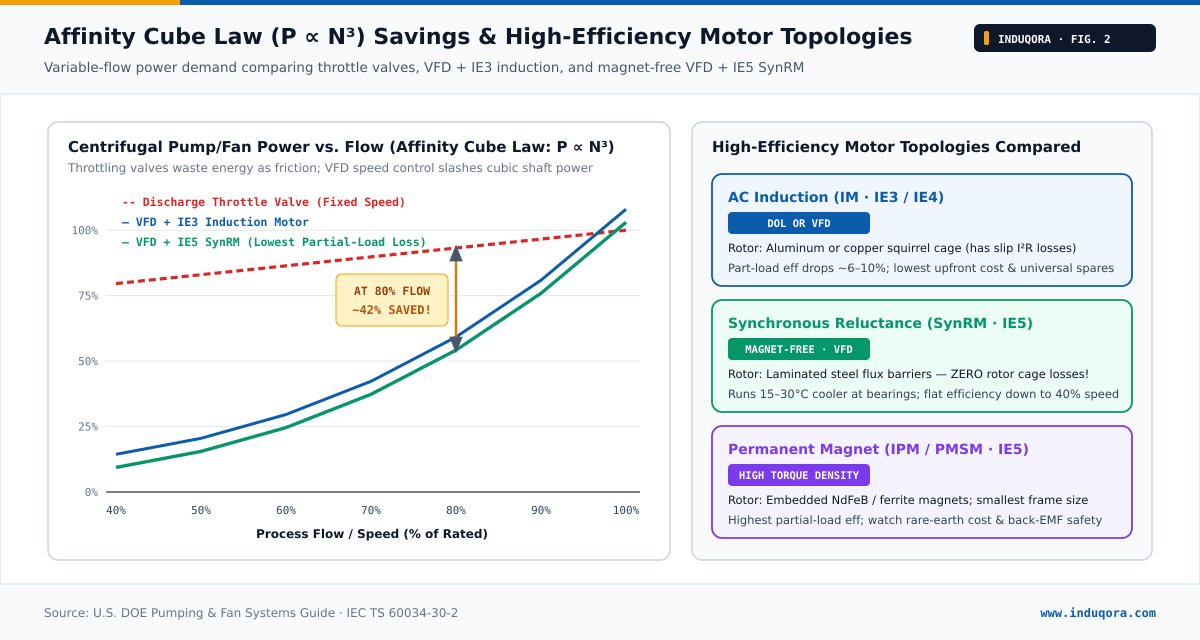
| AC Squirrel-Cage Induction (IM) | IE3 – IE4 | Yes | No | Drops sharply (~6–10% below nameplate) | Rugged, universal spares, lowest upfront price |
| Synchronous Reluctance (SynRM) | IE4 – IE5 | No (VFD required) | No (laminated steel rotor) | Very High (flat efficiency curve) | Zero rotor cage losses → 15–30°C cooler bearings, longer grease life |
| Interior Permanent Magnet (IPM / PMSM) | IE4 – IE5 | No (VFD required) | Yes (NdFeB / Dy) | Highest (compact high torque density) | Smallest frame size; risk of demagnetization if overheated & high back-EMF during fault |
| Ferrite-Assisted SynRM | IE5 | No (VFD required) | No (abundant ferrite) | Very High (better power factor than pure SynRM) | Avoids rare-earth supply risk while keeping smaller VFD current rating than pure SynRM |
Why Partial-Load Efficiency Matters More Than Nameplate Efficiency
Centrifugal pumps, cooling-tower fans, and industrial blowers rarely run continuously at 100 percent flow. Under the Affinity Laws (Cube Law):
- Flow scales linearly with speed:
Q₂ / Q₁ = N₂ / N₁ - Pressure/head scales with speed squared:
H₂ / H₁ = (N₂ / N₁)² - Shaft power scales with speed cubed:
P₂ / P₁ = (N₂ / N₁)³
Cutting pump or fan speed to 80 percent reduces theoretical shaft power to 0.8³ = 51.2% — nearly a 50 percent energy drop compared to throttling a fixed-speed motor with a discharge valve! When a VFD runs an induction motor at 50–70 percent speed and partial torque, rotor magnetizing and slip losses drag efficiency down markedly. By contrast, an IE5 SynRM or PM motor maintains a remarkably flat efficiency plateau across partial speeds, compounding VFD cube-law savings while running cooler bearings (reducing the primary mechanical failure mode in industrial motors).
Worked 10-Year TCO and Payback Analysis (75 kW Continuous Pump)
Compare four real-world replacement options for a 75 kW (100 HP) 4-pole centrifugal process pump operating 6,000 hours/year at an industrial electricity tariff of $0.12/kWh (assuming 80% average load factor = 60 kW shaft output for fixed-speed, or 80% average flow for VFD cube-law control):
| Metric (10-Year Horizon, $0.12/kWh) | Legacy IE2 (Fixed Speed) | New IE3 (Fixed Speed) | New IE4 (Fixed Speed) | VFD + IE5 SynRM (80% Avg Flow, Cube Law) |
|---|---|---|---|---|
| Assumed System Efficiency | 93.8% | 95.0% | 96.0% | 95.8% motor × 97.0% VFD = 92.9% (on ~38 kW shaft load) |
Input Electrical Power (kW) | 63.97 kW | 63.16 kW | 62.50 kW | 41.2 kW (incl. static head allowance) |
| Annual Electricity Consumption | 383,820 kWh | 378,960 kWh | 375,000 kWh | 247,200 kWh |
| Annual Energy Cost | $46,058 | $45,475 | $45,000 | $29,664 |
| 10-Year Energy Cost | $460,584 | $454,752 | $450,000 | $296,640 |
| Estimated Equipment CAPEX | Existing (or ~$5,800) | $7,200 | $8,600 | $18,500 (IE5 motor + VFD + line reactor) |
| Simple Payback vs. IE3 Fixed | Baseline | — | ~2.9 years (on $1,400 delta) | ~0.71 years (~8.5 months) (on $11,300 delta) |
| 10-Year Net Savings vs. IE3 | -$5,832 | Baseline | +$3,352 | +$146,812 |
Engineering Reality Check: Notice two crucial conclusions from this calculation. First, on constant-load fixed-speed applications running >4,000 hours/year, paying the modest premium for IE4 over IE3 typically pays back in 2 to 3 years (often faster in Europe where industrial tariffs exceed €0.18–€0.25/kWh). Second, on variable-flow centrifugal loads with low static head, pairing an IE4/IE5 motor with a VFD delivers an order of magnitude more energy savings than motor-class upgrades alone — though engineers must also budget for VFD harmonic mitigation and bearing current protection so electrical reliability matches energy savings.
Commissioning Checklist When Upgrading to IE4 / IE5 Motors
Upgrading a legacy IE1/IE2 motor to an IE3/IE4 induction or IE5 SynRM design is not always a blind drop-in swap:
- Check Locked-Rotor Inrush Current on DOL IE3/IE4 Induction Motors: Lower-resistance rotors in high-efficiency induction motors often draw 10–25 percent higher locked-rotor starting current and reach slightly higher full-load RPM (lower slip — e.g., 1,485 RPM vs. 1,465 RPM). Verify magnetic-only circuit-breaker trip curves and check that the slight speed increase does not overload centrifugal pumps (
P ∝ N³!). - Verify Frame Size and Shaft Centerline Height: Some cast-iron IE4 induction designs step up one IEC/NEMA frame size compared to legacy IE2 models; SynRM IE5 packages typically preserve standard IEC frame footprints at identical output power.
- Confirm VFD Firmware Supports SynRM / PM Control Modes: Standard scalar (
V/f) drives cannot run Synchronous Reluctance or Permanent Magnet motors cleanly. Verify your drive supports sensorless vector control for SynRM/PMSM and run the standstill/rotating motor ID autotune before coupling the load. - Track Real kWh Baseline in Your Plant Historian / OEE Platform: Capture before-and-after kW meters through your PLC or Unified Namespace / IIoT telemetry layer so finance teams can audit verified payback and unlock utility efficiency rebates.