Every continuous process plant and high-speed discrete factory depends on historical process data — to investigate a reactor excursion, prove FDA 21 CFR Part 11 batch compliance, tune PID control loops, audit OEE production losses, or correlate nuisance trips during an ISA-18.2 alarm rationalization.
Yet teams regularly underestimate the write throughput, storage growth, and security constraints of industrial telemetry. Polling just 25,000 tags at 1-second resolution produces 2.16 billion raw data points per day. Dropping that stream naively into an untuned relational SQL table leads to bloated disks, multi-minute trend load times on operator screens, and permanent data gaps whenever a switch reboots. Purpose-built SCADA historians — and properly architected modern time-series platforms — solve these challenges through specialized ingestion, lossy/lossless compression, edge buffering, and secure multi-tier replication.
Why general-purpose relational databases struggle with raw OT telemetry
Comparing a traditional OLTP database (SQL Server, PostgreSQL without time-series partitioning) against an industrial historian reveals why the underlying storage engine matters:
- Append-only write storms: Industrial collectors write continuous streams of
(TagID, Timestamp, Value, Quality)tuples with almost zero in-place updates. Standard B-tree indexes fragment rapidly under tens of thousands of inserts per second. - Range-scan and interpolation queries: Operators on an ISA-101 high-performance HMI rarely ask for an exact millisecond row; they request 8-hour trends, 1-minute averages, time-weighted totals, or stepped interpolation across 50 tags simultaneously.
- Data quality flags: Industrial values are meaningless without an OPC UA / SCADA quality code (
Good,Bad_CommFailure,Uncertain_SubNormal,Substituted) so engineers can distinguish a flat zero pressure reading from a broken transmitter.
Exception reporting vs. Swinging Door Trending (SDT) compression
The secret behind industrial historians storing 10+ years of plant data on modest disk arrays is a two-stage data reduction pipeline:
Stage 1: Exception reporting (Deadband at the collector)
Exception filtering runs at the interface or edge collector before data even crosses the network to the historian server:
ExcDev(Exception Deviation): A new sample is forwarded only if it differs from the last sent value by more than the configured deadband (commonly0.5×to1×instrument repeatability, e.g., ±0.05 °C on a thermocouple).ExcMax(Maximum Exception Time): Forces a heartbeat sample after a timeout (e.g., 10 minutes) even if the value is completely flat, confirming the interface is still alive.
Stage 2: Swinging Door Trending (SDT) at the historian archive
Once exception events reach the historian, Swinging Door Trending (SDT) — pioneered in industrial historians such as AVEVA PI and widely implemented across SCADA engines — discards intermediate points that fall inside a linear tolerance corridor (CompDev):
- Store the last archived anchor point
P0. - When the next point
P1arrives, open two bounding rays ("pivoting doors") fromP0throughP1 + CompDevandP1 - CompDev. - For each subsequent point
Pk, tighten the upper and lower slopes so all intermediate points stay within±CompDevof a straight line fromP0. - As soon as a new point forces the upper and lower doors to cross (meaning a single straight line can no longer approximate the curve within
±CompDev), archive the previous pointP(k-1)as the new anchor and restart the doors.
Parameter tuning mistakes that ruin plant forensics
Bad compression defaults silently destroy diagnostic value:
- Never apply SDT compression to discrete states, batch IDs, totalizer resets, or alarm counters: Set
Step = ONandCompDev = 0so every state transition is captured verbatim as a square step, never linearly interpolated. - Do not over-compress fast PID or vibration signals: Setting
CompDev = 2%of span on a 0–100 bar header masks ±2 bar valve hunting during loop tuning. For control-loop tags, keepCompDevnear sensor resolution (0.1%–0.25% of span) or disable compression during tuning campaigns. - Always configure
CompMax(e.g., 1–8 hours): Ensures long steady periods still drop periodic archive points, keeping time-range queries fast without scanning days backward to find the previous anchor.
Designing Store-and-Forward buffering for zero data loss
Plant networks experience switch upgrades, firewall maintenance, and WAN link drops. Without Store-and-Forward (S&F) buffering at the edge collector or local SCADA server, any disconnect permanently punches a hole in regulatory and OEE records.
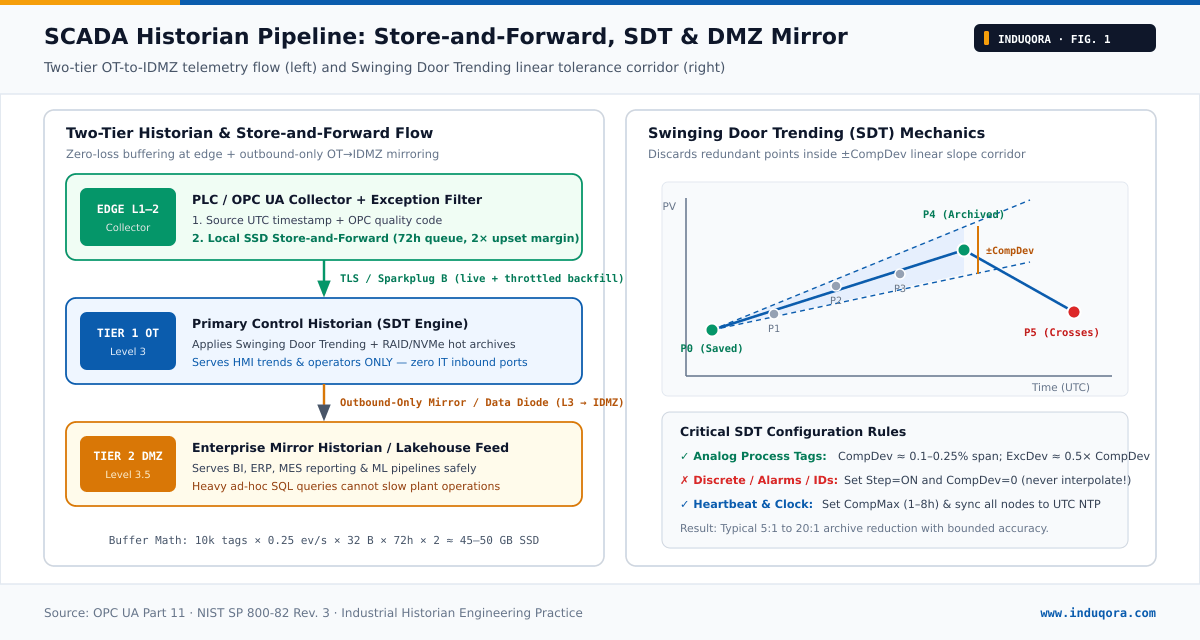
A deterministic S&F buffer must be sized mathematically, not guessed:
Required Disk Buffer (Bytes) = Tag_Count × Avg_Events_per_Sec × Bytes_per_Event × Outage_Seconds × Safety_Factor
Worked sizing example:
- Tag count: 10,000 tags at one collector
- Post-exception event rate: 0.25 events/tag/sec average (2,500 events/sec total)
- Serialized disk footprint: ~32 bytes per buffered event (tag ID, 8-byte timestamp, 8-byte value, quality, checksum/overhead)
- Target outage coverage: 72 hours (259,200 seconds) for a weekend WAN or central server outage
- Raw size:
2,500 × 32 × 259,200 ≈ 20.7 GB - With 2× safety margin (for upset storms where every tag changes every second): allocate at least 45–50 GB of industrial-grade endurance SSD (TLC/pSLC with power-loss protection) exclusively for the local S&F queue, separate from the OS partition so a full buffer never crashes the collector operating system.
When connectivity returns, verify that your collector throttles backfill bandwidth (e.g., capping historical drain to 30% of link capacity) while simultaneously streaming live values so control-room screens do not freeze during multi-hour catch-up.
Secure two-tier DMZ mirroring architecture
Corporate analysts, ERP systems, and machine-learning teams constantly ask for live plant historian access — yet connecting business users directly to the OT historian violates IEC 62443 zones and conduits.
The proven industrial pattern is two-tier historian mirroring across the Industrial DMZ (IDMZ):
- Tier 1 (OT Control Historian — Level 3): Collects data from PLCs/DCS/SCADA via OPC UA, native PLC drivers, or MQTT Sparkplug B. Serves control-room operators and local engineers exclusively. Accepts zero inbound connections from the corporate network.
- Outbound-Only Replication Conduit (Level 3 → IDMZ): The Tier 1 historian initiates an outbound TLS-encrypted replication stream (or passes through a hardware unidirectional data diode) to a Tier 2 Mirror Historian located in the IDMZ.
- Tier 2 (Enterprise / DMZ Mirror): Serves corporate Power BI, SAP/MES batch reporting, and cloud data-lake pipelines (Parquet/Kafka/S3). Even if an analyst runs an unindexed 5-year query that spikes CPU to 100%, the plant's Tier 1 operational historian remains completely unaffected.
Traditional commercial historians vs. modern open time-series stacks
Engineering leaders frequently weigh incumbent industrial historians (AVEVA PI System, GE Proficy, AspenTech IP.21, Ignition Tag Historian) against modern time-series databases (TimescaleDB, InfluxDB, QuestDB, ClickHouse + Parquet):
| Evaluation Criterion | Commercial OT Historian (PI / Proficy / Ignition) | Modern Open Time-Series Stack (TimescaleDB / QuestDB + Edge) |
|---|---|---|
| Native OT Protocol & Quality Support | Turnkey OPC UA/DA, Siemens/Rockwell collectors, built-in quality flags | Requires edge collector (Ignition Edge, Kepware, Node-RED, Telegraf) |
| Swinging Door Compression & Interpolation | Native, mature, battle-tested for decades | Usually relies on columnar/delta/gorilla compression; SDT must be built at edge |
| Regulatory Validation (FDA 21 CFR Part 11) | Pre-documented audit trails, e-signatures, validated workflows | Requires custom governance and validation effort |
| Licensing & Cloud Analytics Economics | Often licensed per tag count; expensive at >500k enterprise tags | Capacity/compute licensing; native SQL, Python, and Parquet lakehouse export |
| Typical Sweet Spot | Regulated pharma/chemical/power plants and fast turnkey SCADA | Multi-site IIoT analytics, high-tag-count smart manufacturing, UNS data lakes |
Many enterprises successfully run a hybrid architecture: keeping a validated OT historian at Level 3 for operators and compliance, while streaming summarized or raw streams via Sparkplug B / OPC UA PubSub into a cloud time-series lakehouse for enterprise analytics.
Time synchronization and operational health checklist
A historian is only as trustworthy as its timestamps. Before handing a historian deployment over to operations, verify these five fundamentals:
- Single authoritative plant time source (NTP/PTP): Synchronize PLCs, SCADA servers, edge collectors, and historians to an internal GPS-disciplined Stratum 1/2 NTP server inside the OT network. Clock skew of even 3 seconds between an alarm server and a historian makes root-cause sequence-of-events analysis impossible.
- Store timestamps in UTC exclusively: Never record local daylight-saving time inside archive files; convert to local plant time only at the visualization layer so autumn DST fall-back hours never overlap or drop an hour of batch history.
- Monitor collector queue depth as a SCADA alarm: Create a heartbeat tag monitoring each edge collector's Store-and-Forward buffer fill percentage and last successful write timestamp — silent buffer overflows discovered months later are a classic compliance failure.
- Separate archive storage from OS and backup targets: Keep active hot archives on fast local RAID/NVMe storage and replicate closed historical archive partitions nightly to immutable off-box backups.
- Audit tag quality ratios monthly: Track the percentage of tags sitting in
BadorStalestate; dead tags left behind after equipment retrofits waste license capacity and clutter operator trends.