Ask two machinists to write the same part and you can predict the difference without seeing the part. One produces a linear file of coordinates with the same pocket profile pasted six times. The other produces a main program that calls a subprogram with parameters, loops it, and fits on two screens. Both cut a good first article. Only one survives the first engineering change.
Program structure in CNC is not an aesthetic question. It is the difference between a change that touches one block and a change that must be found in six places and missed in one of them. The tools are old and standardized — M98/M99 subprogram calls, G65 macro calls with arguments, and macro variables with defined scope — but the scope rules are where programs break, because a variable written in the wrong scope silently shares state across parts, calls or shifts.
M98 and M99: the subprogram layer
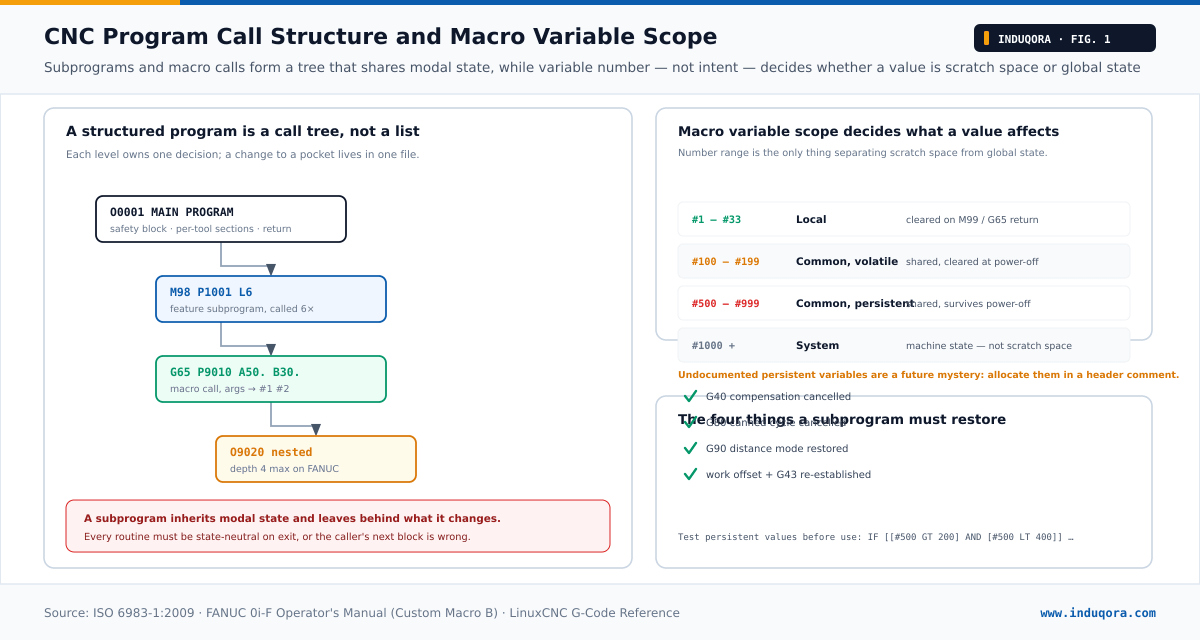
A subprogram is a second program file (or a labelled region, depending on the control) that the main program calls and returns from. On FANUC-family controls the pattern is:
M98 P1001      (call subprogram O1001 once)
M98 P1001 L6   (call it six times)
...
M99            (at the end of O1001: return to caller)
The important properties are easy to state and easy to violate:
- Nesting depth is limited. FANUC permits four levels of nested subprogram calls; recursion into the same subprogram counts against the limit and is a fast route to an alarm mid-cut.
- Modal state is shared. A subprogram inherits the caller's modal state and leaves any state it changes behind. A pocket subprogram that enables
G41and does not cancelG40on exit returns control with compensation active, and the caller's next block is now geometrically offset. M99in the main program behaves differently. Executed at main-program level it loops to the program start rather than returning, which is occasionally useful for a warm-up program and otherwise a way to run a program forever by accident.M99 Pn(return to a label) exists on some controls and is widely misunderstood; it is not portable and should not appear in a program that will run on more than one machine model.
The practical rule is that a subprogram must be state-neutral: whatever modal state it needs, it establishes on entry, and whatever it changes, it restores on exit. G40, G80, G90 and the work offset are the four that matter.
Macro variables: the scope that breaks programs
Macro variables are numbered variables that a program can read and write. On FANUC-family controls the ranges are roughly:
| Range | Type | Behaviour |
|---|---|---|
#1–#33 | Local | Cleared on M99 return and on macro call; used for arguments |
#100–#199 | Common, volatile | Shared across all programs, cleared at power-off |
#500–#999 | Common, persistent | Shared across all programs, retained at power-off |
#1000+ | System | Machine state (position, offsets, alarms) — read-only or dangerous to write |
The scope distinction is the whole point. A local variable is per-call scratch space: pass a value in, compute with it, and it disappears on return. A common variable is global state that outlives the program — deliberately useful for a tool counter or a probe result, and a source of spectacular failures when used by accident.
The classic failure: an operator uses #100 as a loop counter in a warm-up routine, and the same #100 is used by a production macro to hold a probe-derived offset. The warm-up runs in the morning and quietly corrupts the value. #500-series variables are worse in one specific way: they survive power-off, so the corrupted value reappears after a weekend and the investigation starts from a false assumption.
Guidelines that prevent nearly all of it:
- Local variables only inside subprograms and macros, unless persistence is the explicit requirement.
- Allocate the
#500-series by register, documented in a comment block at the top of the program:#500 = tool 1 life count,#501 = tool 2 life count. An undocumented persistent variable is a future mystery. - Never assume a common variable's initial value. Test it (
IF [#500 EQ 0] THEN #500 = 1) rather than trusting the previous run. - Do not use
#100–#199for anything that must survive a restart, and do not use them for anything that must not.
G65: passing arguments without global state
G65 calls a macro program with arguments mapped onto local variables:
G65 P9010 A50. B30. C-2.5 F400.
Inside O9010, #1 holds the A word, #2 the B word, #3 the C word, and #9 the F word. This is the cleanest parameter-passing mechanism in G-code and it is dramatically underused, because many programmers learned to write subprograms that read common variables instead. The difference in maintainability is large: a G65 call is self-documenting at the call site, while a subprogram reading #520 requires the reader to find who wrote #520.
Two constraints are worth knowing before adopting it:
- Argument words are fixed: A–Z map to
#1–#26in a standard order (I,J,Kmap to#4,#5,#6). Using them for anything other than their conventional meaning is legal and confuses everyone who reads the program later. - The local variables are overwritten by the call. Any value the caller had in
#1–#33is gone afterG65, so a program that mixesG65calls with hand-rolled local-variable bookkeeping will surprise itself.
Loops and conditional logic
Macro B (# variables with WHILE, IF, GOTO) turns a control into a limited programming environment. The patterns that earn their place in production:
(Repeat a pocket pattern in X)
#100 = 0
WHILE [#100 LT 6] DO 1
  G90 G00 X[50. + #100 * 40.] Y0.
  M98 P9020
  #100 = #100 + 1
END 1
Two rules keep loops from becoming infinite: always give the loop a counter that a human can inspect on the display, and always make the exit condition dependent on that counter rather than on a computed value that might never be reached. A WHILE loop whose exit depends on a probe reading will run forever when the probe fails, and it will run at feed rate.
For conditional logic, the useful safety pattern is a guarded pre-check rather than a mid-motion decision:
IF [[#500 GT 200] AND [#500 LT 400]] GOTO 9000   (value plausible: continue)
#3000 = 1                                        (raise alarm)
M30
N9000
Testing a persisted value before using it catches the corrupted-variable class of failure at the start of the program instead of at the tool.
Structure as a maintenance decision
A well-structured CNC program for a repeated production part typically looks like this:
- Header comment block: part number, machine, author, revision, tool list, persistent variable allocation, and the parameter assumptions (radius-or-diameter compensation, in particular).
- Safety block:
G40 G49 G80 G90 G94, work offset, spindle mode — establishing state explicitly rather than inheriting it. - Per-tool sections: each opens with its own safety block and
G43, and closes with the tool returning clear and compensation cancelled. - Feature subprograms parameterized by
G65, so a change to the pocket definition happens in one file. - State-neutral exit: coolant off, spindle stop, compensation cancelled, and any persistent counters updated deliberately with a comment.
None of this reduces cutting time by one second. It reduces the cost of the fifth engineering change, which is where most of the money in a production program actually is.