A machinist stops a program mid-cut to change a broken insert, presses cycle start again, and the machine rapids into the part. Nothing in the program changed. What changed was modal state: the cutter compensation, the work offset or the motion mode that was active when the program was interrupted is no longer the mode the control is in when it resumes.
Modal state is the part of a CNC program that is defined once and stays in effect until something replaces it. It is also the part that operators and CAM posts forget, because it is invisible in the program listing. Nearly every "the machine did something I did not program" incident traces back to it.
Why modal state causes crashes
ISO 6983 G-code is not a procedure with local variables. It is a machine-wide state machine. When the program says G01 X100. F200, it does three things at once: selects linear interpolation mode, sets a target position, and sets a feed rate that will remain active for every subsequent block that does not specify another one.
That design is why hand-written G-code is compact. It is also why the control's state at any instant depends on the entire history of the program plus whatever the operator did at the panel. The dangerous cases are the ones where history is rewritten:
- Reset returns most modal groups to machine defaults, but not all of them, and the set differs between controls.
- Power-off loses more state, and on some controls also clears work offsets that were set through
G10rather than stored in the offset table. - Program restart (block search / restart) restores the modes the control believes should be active at the restart block — usually correctly for motion and feed, less reliably for compensation and canned cycles.
- Manual intervention (jog, handwheel,
G53moves, spindle override) leaves modes untouched while moving the machine somewhere the program does not expect.
The failure mode is always the same shape: the program resumes under an assumed state, and the first block that relies on that assumption goes somewhere unexpected.
The modal groups that matter
Most controls organise modal codes into numbered groups where only one member of each group is active at a time. The group numbers below follow the FANUC convention, which is the most widely documented; Siemens ShopMill/840D and LinuxCNC use the same concept with different group numbering.
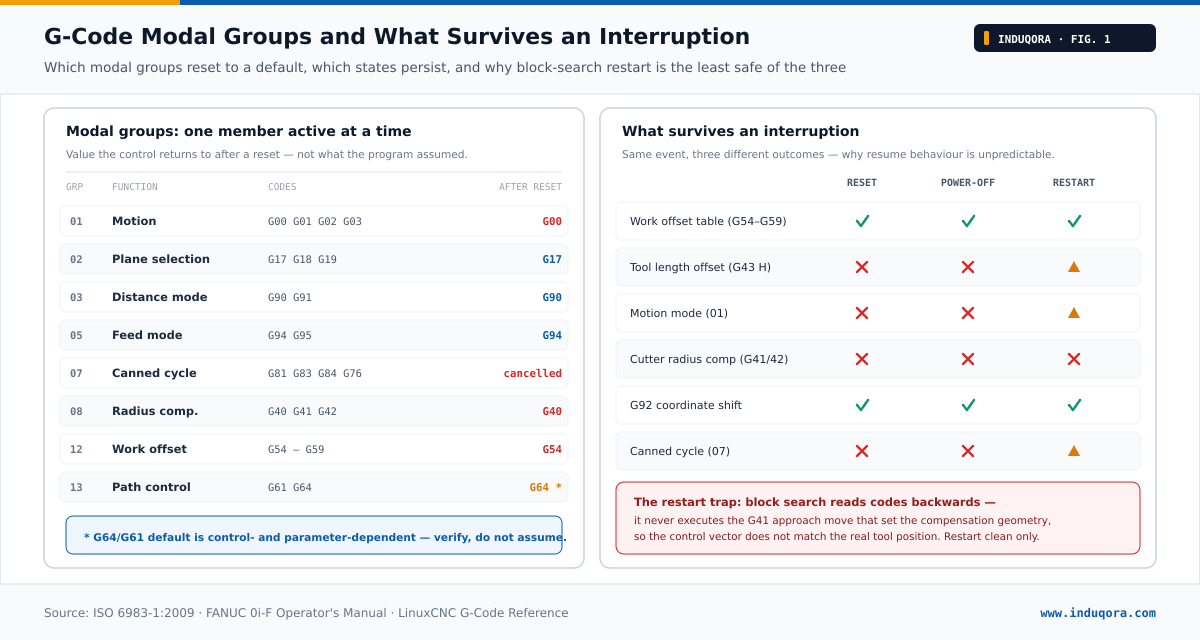
| Group | Function | Common codes | Active after reset |
|---|---|---|---|
| 01 | Motion | G00 G01 G02 G03 | G00 |
| 02 | Plane selection | G17 G18 G19 | G17 (varies by parameter) |
| 03 | Distance mode | G90 G91 | G90 |
| 05 | Feed mode | G94 G95 | G94 |
| 07 | Canned cycle | G81 G83 G84 G76 | Cancelled |
| 08 | Cutter radius compensation | G40 G41 G42 | G40 |
| 12 | Work coordinate system | G54–G59 | G54 |
| 13 | Path control | G61 G64 | G64 (control-dependent) |
| 14 | Spindle mode | G96 G97 | G97 |
Two rows deserve emphasis. Group 12 is the one that moves the part: if a program is written for G55 and resumes in G54, every coordinate is wrong by the offset difference, and on a machine with a large fixture offset that difference can be hundreds of millimetres. Group 13 is the one that changes surface finish silently: resuming in G61 exact-stop when the program expects G64 contouring turns a finishing pass into a stop-start series of witness marks.
G43 tool length compensation and G41/G42 radius compensation live outside the modal group table on some controls but behave modally in practice. They are the most dangerous to lose, because the program was verified with them active and the machine geometry changes completely without them. A G43 that is cleared before a resume means the control thinks the tool tip is at the spindle gauge line.
What survives a reset, and what does not
The practical answer depends on the control, but the pattern is consistent enough to build a procedure on:
Cleared by reset (typical): motion mode, plane, distance mode, canned cycles, cutter compensation, spindle and coolant states, feed and speed overrides, active program pointer.
Persisted in the offset table: work offsets written through G10 and stored, tool length and radius data, parameters. These survive reset and power-off because they live in memory, not in program state.
Persisted only in the program: G92 coordinate shifts. G92 redefines the current position as a new coordinate value, shifting the active work coordinate system. It is modal, it stacks with whatever offset was active, and it is not visible in the offset table. A program that uses G92 for a fixture adjustment and then gets interrupted can leave the machine with an offset that no table shows and that no amount of "check the offsets" will find. G92 is the single most common cause of a mystery shift after a restart, and the reason many shops ban it in production programs in favour of a dedicated work offset.
The practical rule: if a mode must be true for the program to be safe, program it explicitly at the start of every tool section rather than relying on it being inherited. A safety block costs one second of cycle time:
G40 G49 G80 G90 G94 G17
G54
G43 H01 Z50.
M08
That block is the cheapest insurance in the workshop. It makes the program's assumptions explicit and it makes a resume from the middle of the previous operation harmless, because the following block re-establishes them anyway.
Block delete, optional stop and restart blocks
Three control features change which blocks execute, and each interacts with modal state differently.
- Block delete (
/) skips blocks marked on the control. It is normally used for optional clamping, probing or coolant. The trap is that a skipped block may be the only place a mode is set. IfG41is on a block-delete block, the compensation is silently gone and the part is cut to the tool centre line. - Optional stop (
M01) stops only when the panel switch is on, so the same program behaves differently depending on a physical switch. Programs that rely onM01for inspection stops must not depend on the stop for state changes. - Restart block / block search jumps into the middle of a program. The control scans backwards to reconstruct modal state, but reconstruction is not the same as execution: it reads codes, it does not simulate them. Cutter compensation is the classic casualty, because the approach move that establishes the compensation geometry never physically happens. Restarting inside a compensated contour is unsafe on nearly every control, and the standard advice is to restart at a point before the compensation was applied.
The safe restart points are the ones the program was written to have: after a tool change, at a clearance plane, at a G40-clean boundary. If a program has no such points, it cannot be restarted safely, only re-run.
A modal state audit for shift handover
The audit takes about a minute per job and catches nearly all of these failures:
- Confirm the active work offset on the position display, and confirm it matches the setup sheet — not the last job.
- Confirm
G43and the activeHnumber against the tool in the spindle. - Confirm
G40(no compensation) andG80(no canned cycle) before any manual move. - Confirm distance mode
G90and feed modeG94before restarting. - Park with
G53(non-modal machine coordinate move) rather than a work-coordinate position, so the park location is independent of the offset. - After any
G92in the program, verify the offset table has not been disturbed, and prefer rewriting the program to use a real offset.
None of this needs a parameter change or a new control. It is entirely a discipline question, which is why it survives machine upgrades: the newer the control, the more state it keeps, and the more there is to be wrong about.
Modal state is the interface between the programmer's assumptions and the machine's reality. Programs that assume little are portable, restartable and safe; programs that assume a great deal are fast to write and fragile in service. For production work the second kind is a false economy.