CANopen is a small protocol riding on a small bus, and both facts are why it is used on machines that must run for twenty years. It is also why it fails in ways that look like hardware faults: a drive that drops out of operational state, a torque command that arrives one cycle late, a parameter write that blocks the bus for 40 ms in the middle of a move. All three are configuration and scheduling problems, and all three are visible from a Rust program with socketcan.
This guide works through CiA 301 from the point of view of a controller that must keep a bus alive, not from the point of view of a protocol explanation.
The two channels and why they must never mix
Every CANopen device exposes an object dictionary — a table of parameters indexed by a 16-bit index and an 8-bit sub-index. Two protocols read and write that table:
| Channel | Purpose | Identifier | Timing |
|---|---|---|---|
| SDO | Read/write any object by index | 0x600 + node / 0x580 + node | Request-response, can block |
| PDO | Exchange mapped process data | 0x180 + node / 0x200 + node (defaults) | Cyclic, synchronous or event-driven |
| NMT | Change device state | 0x000 | Broadcast or node-specific |
| SYNC | Trigger synchronous PDO exchange | 0x080 | Fixed period |
| Heartbeat | Prove the node is alive | 0x700 + node | Fixed period |
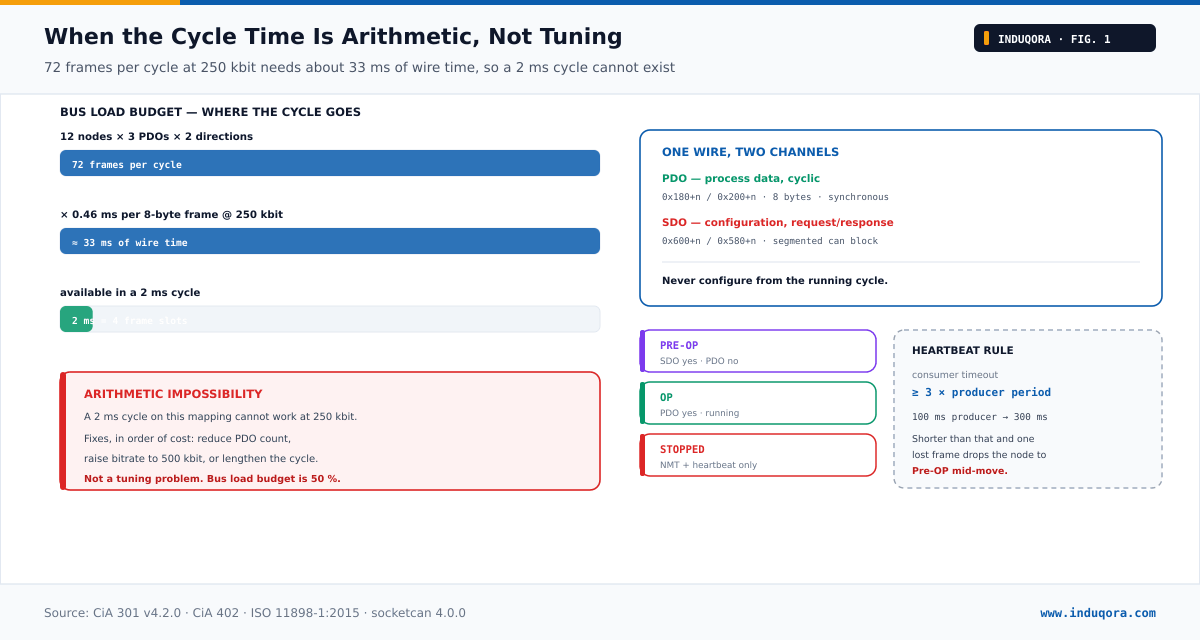
The rule that prevents most production incidents: SDO traffic must not share a cycle with time-critical PDO traffic. An SDO write of a large object uses segmented transfer, which is a sequence of request-response pairs, each of which waits for the device. On a 250 kbit bus a multi-segment SDO can occupy tens of milliseconds. If the drive is expecting PDOs at 2 ms during that window, it will either miss setpoints or trigger a communication watchdog.
Configure the device offline, or in pre-operational state, and never from the running cycle.
Mapping arithmetic that decides your bus load
PDO mapping determines which objects are packed into each frame. The constraint is 8 bytes per CAN frame — classic CAN, not CAN FD — and that is a hard budget.
A typical drive with three RPDOs:
| PDO | Content | Bytes |
|---|---|---|
| RPDO1 | Controlword (0x6040), target velocity (0x60FF) | 2 + 4 = 6 |
| RPDO2 | Modes of operation (0x6060), target torque (0x6071) | 1 + 2 = 3 |
| RPDO3 | Digital outputs (0x60FE sub 1) | 4 |
Each frame carries about 47 bits of overhead at standard arbitration, so an 8-byte payload occupies roughly 111 bits of bus time. At 250 kbit that is about 0.44 ms per frame including inter-frame space. A 12-node network with 3 PDOs each in both directions is 72 frames per cycle, which needs about 32 ms of bus time — so a 2 ms cycle on that configuration is arithmetic impossibility, not a tuning problem.
The bus load budget to design against:
| Bitrate | Bit time | 8-byte frame time | Frames per 10 ms at 50 % load |
|---|---|---|---|
| 1 Mbit | 1 µs | ~0.13 ms | ~38 |
| 500 kbit | 2 µs | ~0.25 ms | ~19 |
| 250 kbit | 4 µs | ~0.46 ms | ~10 |
| 125 kbit | 8 µs | ~0.9 ms | ~5 |
Keep sustained bus load below about 50 % and you retain headroom for SDO diagnostics, heartbeat and error frames. Above 70 %, error frames from a single faulty node can push the bus into error-passive behaviour and the whole network degrades at once.
NMT and the state machine that stops machines
Every device follows the same state machine: Initialising, Pre-operational, Operational, Stopped. The transitions matter:
- Pre-operational: SDO works, PDO does not. This is where configuration belongs.
- Operational: PDO works. Configuration can still be done, but should not be.
- Stopped: only NMT and heartbeat work.
A device that silently returns to Pre-operational stops accepting PDOs and, depending on the drive, may drop its output stage. The usual cause is a heartbeat or node-guarding timeout: the controller stopped sending heartbeats for longer than the consumer's timeout, and the consumer decided the network was dead.
Two design decisions follow:
- Heartbeat producer period and consumer timeout must satisfy
timeout ≥ 3 × producer period. A 100 ms producer with a 300 ms timeout survives two lost frames. A 100 ms producer with a 100 ms timeout fails on the first lost frame, which happens on every bus with any EMI. - Startup must be sequenced. Sending NMT Start to all nodes at once floods the bus with boot-up messages and the transition responses collide. Start nodes one at a time with a short delay, or use a staggered schedule.
Driving it from Rust
The socketcan crate 4.0 exposes the raw CAN interface; CANopen framing is your code. That is appropriate, because the CiA 301 frame layouts are short and stable.
[dependencies]
socketcan = "=4.0.0"
// compile-check: library
use socketcan::{CanFrame, StandardId, EmbeddedFrame};

/// NMT: set one node to operational. Payload is [command, node id].
fn nmt_start(node: u8) -> CanFrame {
    // StandardId::new returns Option<StandardId>; 0x000 is always valid.
    let id = StandardId::new(0x000).expect("valid 11-bit id");
    CanFrame::new(id, &[0x01, node]).expect("2-byte payload fits")
}

/// SYNC: zero-length frame on COB-ID 0x080.
fn sync() -> CanFrame {
    CanFrame::new(StandardId::new(0x080).unwrap(), &[]).expect("empty payload")
}

/// Decode a statusword (0x6041) from TPDO1 — little endian per CiA 301.
fn statusword(frame: &CanFrame) -> Option<u16> {
    let d = frame.data();
    (d.len() >= 2).then(|| u16::from_le_bytes([d[0], d[1]]))
}

// The tokio wrapper implements Stream for received frames and write_frame for TX.
// socket_tx.write_frame(sync()).await?;
With socketcan::tokio::CanSocket the cycle becomes a select over the socket and a timer, and the same zero-allocation discipline applies as on any real-time bus: no formatting, no logging and no Vec growth in the cycle body.
Two practical notes from the crate source that save debugging time:
CanSocket::open("can0")takes the interface name; the interface must already be up and configured at the right bitrate withip link set can0 type can bitrate 250000.- Received frames carry a timestamp from the kernel. Use it for jitter measurement rather than calling the clock after the read, because the read may be delayed by the scheduler.
Heartbeat, node guarding and the choice between them
Heartbeat and node guarding solve the same problem in different ways, and mixing them on one network is a reliable way to produce confusion:
| Mechanism | Direction | Failure detection | Notes |
|---|---|---|---|
| Heartbeat | Producer → consumer(s) | Consumer timeout | One frame per period, any number of consumers |
| Node guarding | Master polls each node | Response timeout | One request-response per node per period |
Node guarding costs two frames per node per period and scales badly: 20 nodes at 100 ms is 400 frames per second of pure overhead. Heartbeat costs one frame per node per period and should be the default on any new design. Set consumer timeouts to at least three producer periods.
Commissioning checks worth automating
Four checks catch most CANopen integration problems before they reach a machine:
- Bus load measurement at the intended cycle.
candump -tawith a frame count over ten seconds, then compare against the table above. If it exceeds 50 %, change the mapping or the bitrate before anything else. - Per-node heartbeat monitoring from cold start. Log the time from power-on to first heartbeat for each node; a node that takes 4 seconds while others take 400 ms will make your startup sequence look intermittent.
- Error counter monitoring. Read the CAN controller error counters (
ip -details -statistics link show can0). A rising error counter is cabling, termination or a baud mismatch — never a software problem. - SDO round-trip timing per node. A node that answers in 5 ms is healthy; one that answers in 80 ms will block your configuration sequence and hints at a firmware problem.